
FASHION IMAGES MATTER
an essay by the African Fashion Research Institute (AFRI) DR ERICA DE GREEF, JOHANNESBURG, FEBRUARY 2026
Fashion images matter. They act as evidence, as sites of material, socio-political, and cultural knowledge. Paintings, and portraits in particular, precluded the words that fill fashion textbooks as the site of culture, aesthetics, and the material representations of the day. Photographs now fill the textbook, their promise of truth eclipsing the speed of the fashion sketch and portraiture’s need for realism. It is the fashion photograph that represents history. Vernacular photographs, on the other hand, only occasionally become the historical referent. Yet, we all know that the fashion photograph presents a construct, an ideal, a speculative ‘no-place’ utopia that is only a small part truth and a large part fiction. This half-lie becomes the archive. Perhaps, not unlike all archives: they are constructs, fragments of truth. Only part of the event, part of the story, part of the picture. Fashion photographs carry the grammar of fashion through time, as flawed yet aspirational representations of fashionable facts.
These potentials of future writing and archival welcome vested in the fashion image mean that the fashion photograph either quickly fades from view – as many do – or, in retrospect, becomes the iconic image, the canon of innovation, the marker of a style zeitgeist. The power of the fashion image thus lies in its capacity to craft future histories1 And so, we ask, rather than dismiss fashion images as transient, that we pay closer attention to the futures they bring into view and how they make visible our sensibilities, identities, and imaginaries. The fashion photograph carves a powerful pathway of possibilities, of what could be, of desire, identity, intimacy, and pride. It is an acknowledgement of the familial and familiar, yet each time presenting afrocentric future visions anew.
The fashion photograph is also always a collective project. With the pioneering work of Lesotho-born photographer Koto Bolofo, to the memorable, early 2000 images by streetstyle photographer Nontsikelelo Veloko, and the enigmatic, groundbreaking images of Tatenda Chidora, Aart Verrips, Kristin Lee Moolman, and Andile Buka, amongst others, this exhibition aims to bring a spotlight to the collaborative poetics and politics of the fashion photograph. It differs from the ethnographic record; it borrows from the world of art; it takes its lessons from vernacular portraiture; yet, it always seeks innovation. The fashion photograph becomes. It is the outcome of an
________________
1 De Perthuis, Karen. 2022. ‘The utopian "no-place" of the fashion photograph’ in Eds. Kollnitz, Andrea, and Pecorari, Marco.
Fashion, Performance, and Performativity: The Complex Spaces of Fashion. London. Bloomsbury Visual Arts. P145-160.
expressive choreography – of designers, stylists, photographers, make-up artists, hairstylists, assistants, location scouts, agents, models, and often more – that this exhibition honours, without whom these future visions would elide.
A Sense of Fashion: Beauty as Knowledge
I continue to think about beauty and its knowledges (Sharpe, 2019).
A pair of interlocked hands is nestled in a dark, chocolate-brown mohair knit by Pariah. The tender, pensive moment – of mother and child – is caught in the early morning light. Alexa Singer’s portrait of Fidel offers an intimate whisper of tender trust in an oft-divided world. Like yin and yang, model Nondumiso Beattie, wearing a lightly textured, ivory gaberdine suit by Kluk CGDT, performs a poetic continuum of brown and albino white in a play of light and shadow. Quiet activism belies this gentle meditation, portraying resilient tenacity that speaks louder than words.
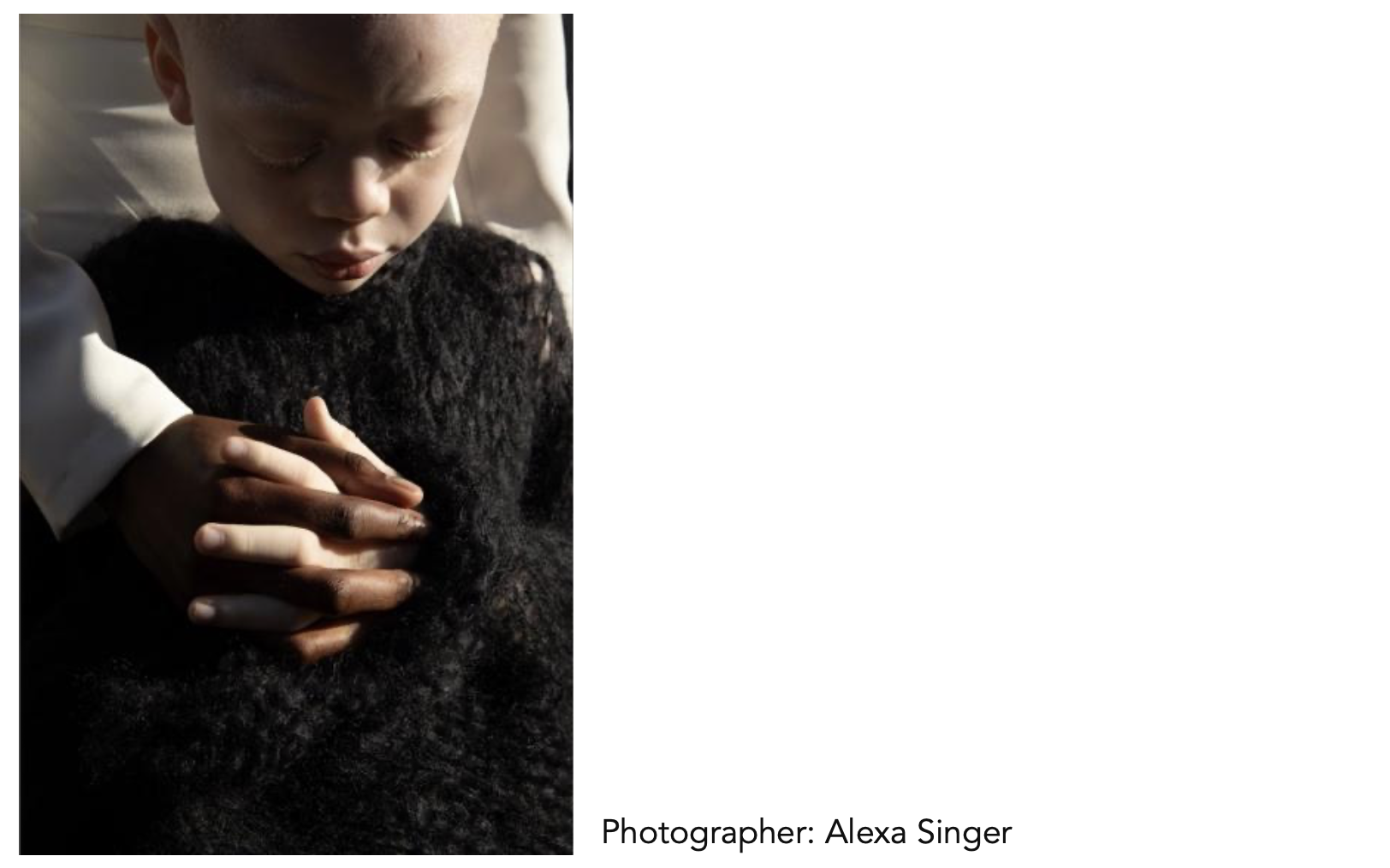
Singer’s photograph pierces the space in its quiet resolve. It joins Steve Tanchel’s timeless portrait of model Diandra Forrest wearing Suzaan Heyns in a diptych across time. In a world filled with multimedia and moving images and audiovisuals, we are invited to pause, to slow our viewing, to witness the fluidity of fashion. Slow looking – like the slowing of the camera shutter – brings into view moments, at times fragile, at times striking. We become silent witnesses to encounters otherwise unseeable.
Photographer Nico Krijno’s ensemble of models wearing Viviers counterbalances the poetry of movement in Aart Verrips’ take of models Goliath Gilbert and Phumlani Mndebele wearing Uniform by designer Luke Radloff. Shelley Mokoena’s ascent in the dark of night echoes the fleeting moment of Steve Tanchel’s poetic document of Josh Habib wearing Laduma. From movement to stillness, we become part of what Ariella Azouley describes as the contract of photography.2 The choreography between bodies – of models, photographers, stylists, and designers – and the contract of our viewing. We are socially contracted to look at these images of models, knowing that they know that they will be looked at by us – this looking is its purpose. But to be seen is different from being looked at. In this exhibition, we invite a looking beyond, a listening to the images.
Drawing on Tina Campt’s provocation to ‘attend to the photograph by way of the unspoken relations that structure them’, we set them in relief – with each other and across time – to juxtapose their sonic, haptic, historical, and affective backgrounds and foregrounds, through and against which we come to view them. 3 Ross Garret’s striking photograph of model Aluad Deng Anei wearing a Guillotine, Michael Oliver Love’s take on models against a clear blue, highveld sky wearing hats by designer Crystal Birch, and model Thapelo Mofokeng wearing Viviers, whose image is partly refracted in public swimming pool waters, present moments in the hot sun. Who are these individuals, and how do we engage these gestures of closeness, these proximities to lives lived? We are invited into a scene, a moment of being, an intimacy in space. In Justin Dingwall’s dreamlike portrait of model Mariska Pretorious wearing Clive Rundle, and Marguerite Oelofse’s painterly render of Kirsty McKenzie also wearing Clive Rundle, we enter worlds of surreal beauty and its other.
Writing over a century ago, Walter Benjamin frames the photograph: ‘with the close-up, space expands; with slow motion, movement is extended. The enlargement of a snapshot does not simply render more precise what in any case was visible, though unclear: it reveals entirely new structural formations of the subject, as a different nature opens itself to the camera than opens to the naked eye. The camera introduces us to an unconscious optics. 4 Locating our relations to the symbolic proximities within these photographs invites the intimacies of being there, a social and cultural locus in time and place.
In a profusion of intersecting colours and lines, models Kuany Atem and Temitope Ajayi lean in towards each other. Twinned in matching black and white Thebe Magugu three-piece ruched djellabas, trousers, and oversized headwraps, their sharp Thebe Magugu stiletto pumps point outwards to the corners of the frame. Like weapons on the patterned vinyl kitchen floor, they channel the vortex of smudgy hues from the back wall. In this image, Nadine Jewere pays homage to the studio
________________
2 Azoulay, Ariella. 2008. The Civil Contract of Photography. London. Zone Books
3 Campt, Tina. 2017. Listening to Images. Durham and London. Duke University Press.
4 Benjamin, Walter. 1969 (1935). The Work of Art in the Age of Mechanical Reproduction’ in Ed. Hannah Arendt. Illuminations.
New York. Schocken Books.
photographers such as ZJS Ndimande and Singarum Moodley, aka Kitty, and others. A retro melamine drop-side table proudly displays the lily of Saint Joseph in a fired ceramic pot that echoes the two-tone hues of the room, a symbol of faith and family but also of Sunday best. Unapologetic glamour swirls in an explosion of lines, and the undeniable presence of the feminine is coiled like a spring, readied for divine intervention.
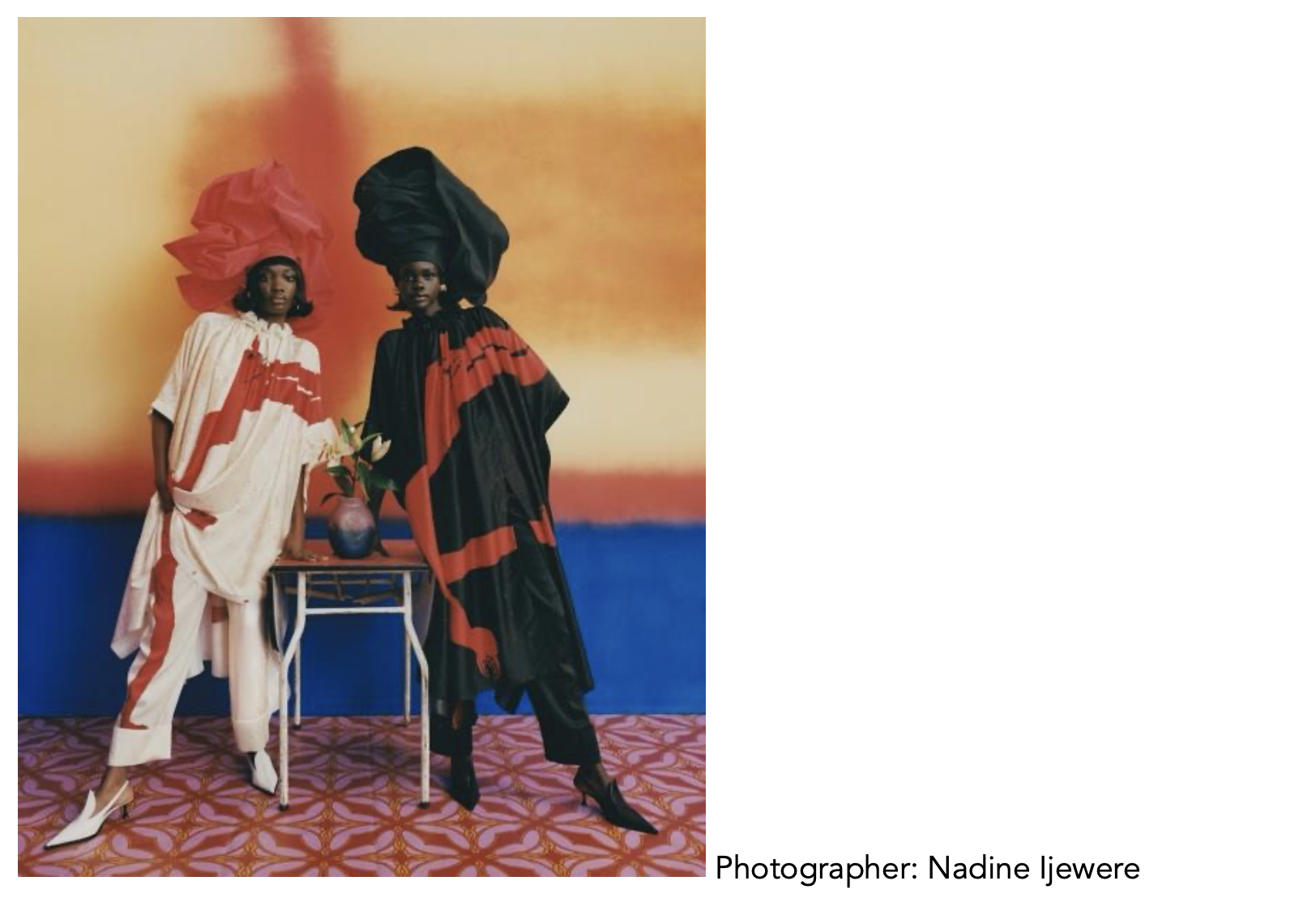
Beauty as witnessed in these moments of self-making – as a form of sovereign representation – has long served as a site of cultural repair on the continent, an everyday strategy of affirmation, a confrontational practice of visibility. Attending to the frequencies of these photographic histories means being attuned to the connections between what we see and how it resonates locally, and continentally, of memories stored in suitcases and shoeboxes, on fridges and in framed family photos.
As Christina Sharpe notes, the image of beauty has worked across very diverse modes of memory that include photography. 5 These cinematic sites of self-fashioning offer black historiographies that transcend erasure. As a method, Sharpe asks, what might beauty mean or do: what might it break open, rupture, make possible and impossible, and how might we carry beauty’s knowledge with us to make new worlds?
New realities of body and dress are conjured into existence and captured in the studio, as seen in Paul Shiakalis and Pieter Hugo’s minimalist portraits of Fikile Sokhulu and model Mitchell Akat wearing Thebe Magugu, respectively, with the metamorphosis of fashion that comes into being, over and over again. Faith Johnson, wearing Papama Mtwisha, is shot by Kevin Mackintosh, saturated in deep immersive red. In a play of graphic lines, dynamic volume, and liquid shapes, Brett Rubin’s take of Refiloe Seretlo wearing Row-G and Aart Verrips’ images of Lebo Malope wearing Rich Mnisi, and Nelson Maker wearing Chulaap, locate each of these material visualities in dreamlike worlds, as symbiotic bodies and garments in space.
Grounded in a symbiosis of body, fashion, and rocky landscape, is photographer Ulrich Knoblauch’s striking portrait of model Pivot A wearing the dreamy, long-sleeved two-piece suit by Amanda Laird Cherry. Each new collection, each new season, these fashionable looks are captured. It is in the fashion photograph that impermanence survives. In Fashion_The Image, we find all the marks of becoming, of remembering, of emergent visions, of surprising beauty, of radical intimacies, and of decolonial possibilities.
Movers and Makers
Beauty is not a luxury, writes Saidiya Hartman, it is a way of creating possibility in the space of enclosure.6 In this ensemble of images, we witness how the fashion photograph has interrogated, interrupted, reimagined, and transformed the norms and ideals of gender, style, and identity. Shot on location, the city of Johannesburg frames these transformations with the work by trailblazer Nontsikelelo Veleko from the Beauty is in the Eye of the Beholder series, a project that she started in 2003, two years before the New York blogger launched The Sartorialist. Veleko photographed a new generation of post-apartheid designers, Floyd Avenue, wearing Floyd Avenue, and Sibu FDB, wearing FDB Human Store, and many others in the streets of Newtown, Johannesburg. Capturing their style narratives too, was photographer Chris Saunders, whose ongoing image-making practice has centred on the histories and contemporary style narratives of township-based street cultures.
Another architect in fashion photography in the city, Andile Buka, paved the way for a new generation of photographers with his seminal projects, such as The Sartists Sport Series (2014), which recently featured in the groundbreaking Fashion Accounts in Museum Africa exhibition (2024-2025). The iconic duo shot in this image, of rising designers Thebe Magugu and Wanda Lephoto, wearing Thebe Magugu and Wanda Lephoto in 2022, shifts the perspectives of formality and fame, creating a playful illusion against an orb of glowing red.
________________
6 Hartman, Saidiya. 2019. Wayward Lives, Beautiful Experiments: Intimate Histories of Riotous Black Girls, Troublesome
Women, and Queer Radicals. London. Serpent's Tail.
New York. Schocken Books.
Aart Verrips’ candid portrait of Nkuley Masemola dressed in oversized Nhlanhla Masemola occupies the page in a hexagram of folds, whilst Ray Manzana’s shot of model Emmanuel Tjiya wearing a garment crafted with a pair of appliqued elephants by Gert-Johan Coetzee is hosted by a soft, shadowy backdrop. Lethabo Machele photographed model Phetogo Kgosierileng wearing Gift Kgosierileng in a synergy of flight and light. Pitsi Tshipi wearing Tshipi Vintage is framed by Antonia Steyn against a wall of the sepia-toned shadows of an urban apocalypse. Using a low angle, Lerato Mbawu dressed Mr Mthethwa in BOYDE, and captured the Swanker, styled with a vintage Valiant in front of a 1960s apartment block in one of Johannesburg’s many, mid-century suburbs. This patchwork of past and present performs the aesthetics of a city that simultaneously, and continuously returns to, and reinvents itself.
In a triptych of black and white, Tatenda Chidora’s photograph of model Constance Moore for Mmuso Maxwell, Steve Tanchel’s photograph of Samuel L. Jackson wearing Naked Ape, and Aart Verrips’ dynamic capture of Ephymol wearing Ephymol point to the emergence of a different aesthesis, a return to Koto Bolofo’s ongoing resonances in the work of fashion photography on the continent. In Carol Tulluch’s words, they mark a return to the birth of cool, of black style as not only an indicator of difference, but as a marker of an aesthetic of presence that imprints the sense of self on society and culture. 7
That the fashion photograph is a legitimate place for discourse, one where otherness is made visible, and bodies and style narratives that were traditionally excluded come to matter, marks this anthology of images with a pulse of the new. Writing about her mother’s set of neatly arranged dressmaking pins, Christina Sharpe points to attentiveness whenever possible as a kind of aesthetic that escaped the violence of erasure – even if it was only the perfect arrangement of pins. 8 In these photographs, we witness the cultural politics of attentiveness as the tool that reflects the dynamics of future histories nurtured by the sartorial spirit in Johannesburg.
Utopian Land
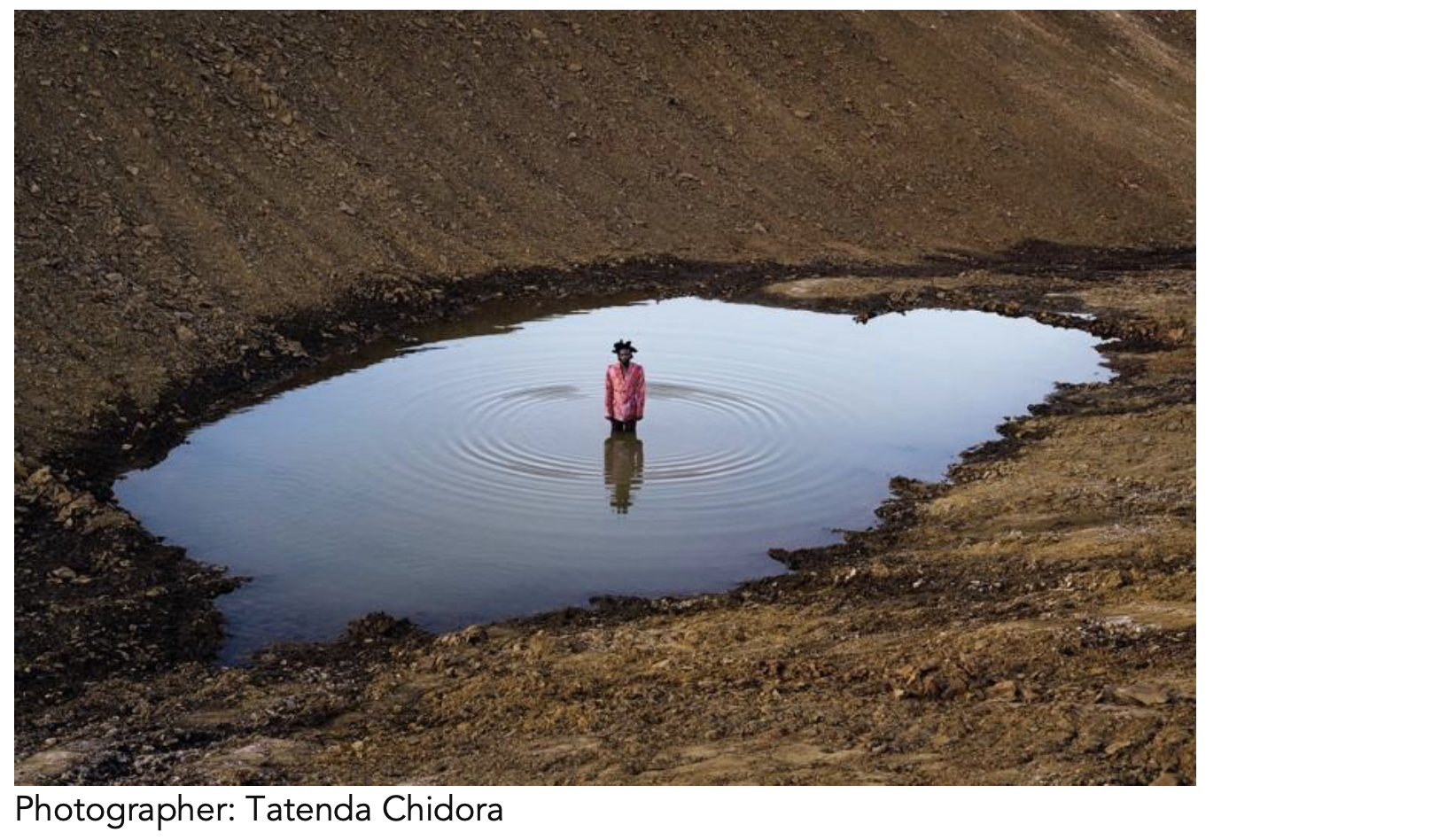
Wearing a red, pink and orange splattered satin tailored jacket by designer Nao Serati, model Desire Marea stands with hands gently closed – as if holding onto something secret – thigh-deep in the centre of a ripple of cloudy, pale blue water. The pool of water, a distorted ellipse, extends silently beyond his frame. A dark streak of alchemical reactions encircles where water and land meet, where the scarred, barren landscape of golden basalt and chipped rock rises. With an unwavering gaze, Marea’s presence produces a single pulse, a heartbeat in the watering hole. His reflection in the ridges of the ever-widening liquid stillness is totemic. His figure is dwarfed by eco-violence – by the toxic remains of extraction. In a precarious
________________
9 Akomolafe, Bayo. 2018. The Times Are Urgent: Let’s Slow Down. https://www.bayoakomolafe.net/post/the-times-are-urgent-
lets-slow-down
apocalypse, where this touchpoint of life – water – no longer finds the trees, photographer Tatenda Chidora prompts a deep reckoning with our vulnerability.
Born along a similar existential vein, the triptych of photographs by Merwelene Van Der Merwe, Kevin Mackintosh and Ross Garrett each situate Black Coffee’s 2009 Mercedes-Benz award-winning collection in barren and desolate landscapes. The siren red viscose knit ensembles, replete with pompom scarves and knitted beanies, perform a cultural fusion, a layered hybridity, a kind of social dreaming. Precarity is no longer a future dystopia. In the current crises of eco-violence and climate collapse, we need dreams, we need hope. In urgent times, writes Bayo Akomalafe, we need to slow down. 9
These photographer-designer collaborations raise the call for collective ecological, cultural and environmental repair. Grounded in a phantasmagoria of ruins, photographer Roger Ballen’s portraits featuring archival pieces from David Tlale worn by model Sarie Pretorius, offer a psychological, semiotic rendering of contemporary fashion. A stark reminder of the complex interplay between wearing the animal and becoming animal. Equally disquieting, Steve Tanchel’s portrait of Kaone Kairo wearing Thula Sindi harkens to a world where nature retaliates, where the stillness is not silent, and where dreamscapes unsettle. Achille Mbembe reminds us to attend to all that is happening amidst our return to the big questions of what constitutes human life, and how we are to communicate
________________
6 Hartman, Saidiya. 2019. Wayward Lives, Beautiful Experiments: Intimate Histories of Riotous Black Girls, Troublesome
Women, and Queer Radicals. London. Serpent's Tail.
New York. Schocken Books.